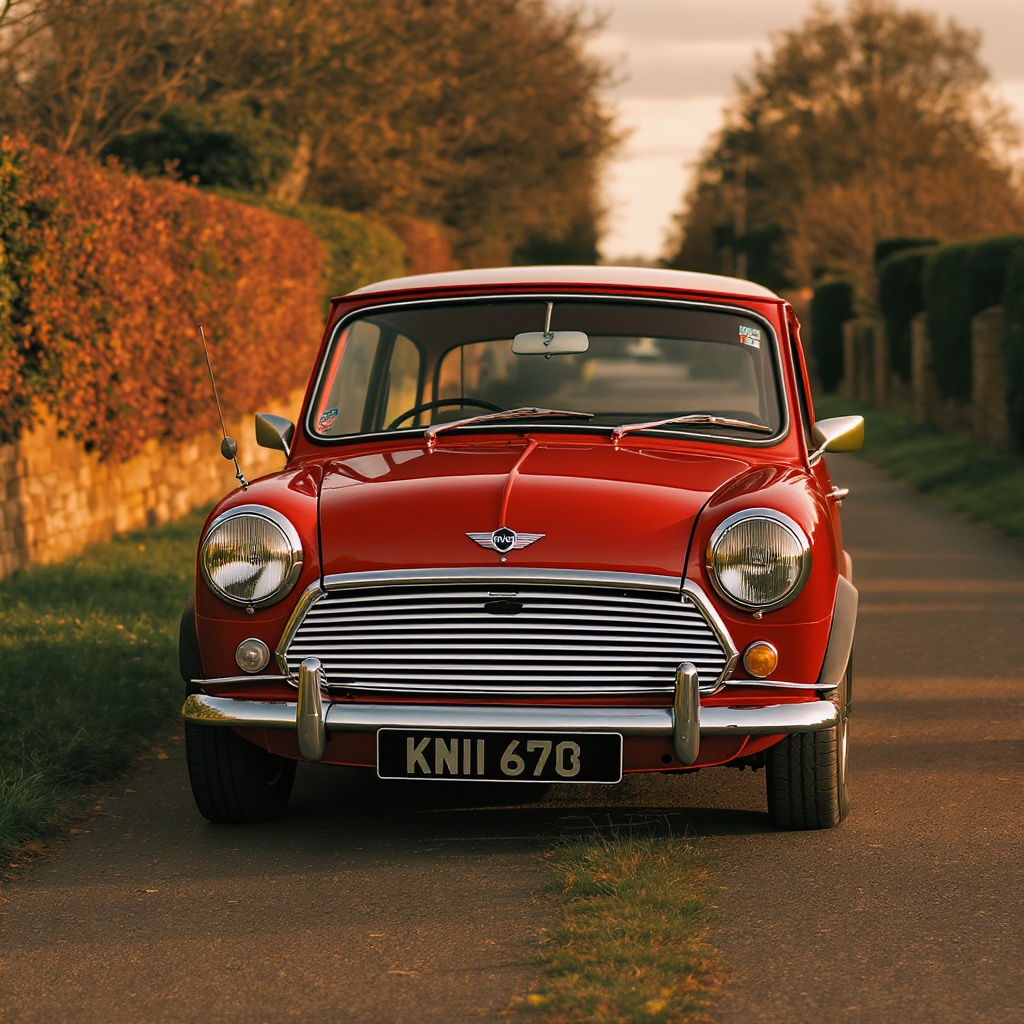
The Marque
“The car that rewrote the rules.”
Not a bad epitaph. But then the Mini earned it.The Mini Cooper arrived in 1961, when John Cooper recognised that the recipe he’d helped develop for BMC’s formula racing programme was good enough for the road. A few engine modifications, a deeper sump, better brakes: 55 bhp from 997cc, and a car that changed what a small car could be. The Cooper S followed in 1963, carrying the forged-crankshaft bottom end that made the A-Series engine genuinely robust under competition loads, and the competition record — Monte Carlo wins in 1964, 1965, and 1967 — confirmed what road drivers had already worked out: this was a machine with no legitimate peer in its class.
The 5,387,862 Minis produced between 1959 and 2000 represent every variant of that original concept — 848cc economy, Cooper sport, Cooper S competition, Clubman estate, 1275GT fastback, and the late MPi models carrying the same A-Series engine into the 2000s. All of them carry the same bones, the same spirit, and the same parts-finding challenges. This guide covers them all.
Can’t identify the part you need? Describe it in plain English, upload a photo, or paste a part number. CarSpanner identifies Mini Cooper components from casting marks, part numbers, physical characteristics, and vehicle context — and cross-references against the specialist suppliers most likely to stock it. Find a Mini Part →
A-Series Engine Coverage
The BMC A-Series engine is the Mini — in the same way that the flat-six is the 911 or the Windsor small-block is the Mustang. It arrived in 1951 with the Austin A30, was redesigned for the Mini in 1959 with the transversely-mounted configuration that changed automotive architecture forever, and remained in production until October 2000 when the last Mini Cooper Sport 500 rolled off the line.
The A-Series is a cast-iron block with a steel crankshaft, three main bearings, and a camshaft running in the block. The cylinder head is crossflow — inlet on one side, exhaust on the other. The engine sits sideways in the Mini’s engine bay with the gearbox beneath the oil pan — a configuration that freed enormous interior space but demanded a narrow engine and a fundamentally different approach to cooling and service access.
| Engine | Code | Years | Power | Key Feature |
|---|---|---|---|---|
| 848cc | 8G/8H prefix | 1959–1980 | 34 bhp | Original Mini engine, collectable in MkI cars |
| 997cc Cooper | — | 1961–1964 | 55 bhp | First Cooper engine, 62.43mm bore |
| 1070cc Cooper S | 9F prefix | 1963–1964 | 70 bhp | Oversquare, EN40B forged crank |
| 970cc Cooper S | 9F prefix | 1964–1965 | 65 bhp | Shorter stroke version of 1070cc |
| 1275cc Cooper S | 12G/9F prefix | 1964–1971 | 65–76 bhp | The definitive Cooper S engine |
| 1275GT | 12H prefix | 1969–1979 | 60 bhp | Fastback version with 1275cc |
| 998cc (standard) | 99H prefix | 1969–1980 | 38–45 bhp | Replaced 848cc as the standard engine |
| 998cc A-Plus | A+ casting | 1980–1996 | 40–45 bhp | Improved oil pressure, different head bolt pattern |
| 1275cc MPi | TPi/A+ | 1990–2000 | 50–63 bhp | Multi-point injection, final production engine |
The Crankshaft Question
This matters more than most buyers realise. Only the Cooper S engines with ‘9F’ prefix blocks had an EN40B forged steel crankshaft — significantly stronger than the EN16T steel item used in all other A-Series engines, which was only tufftrided on the Mk3 ‘S’ and Austin 1300GT. For a driver or restoration, the standard EN16T bottom end is fine. But for any performance build, or for checking the bottom end on a claimed Cooper S, the ‘9F’ prefix and the EN40B crank are the defining confirmation. If you have a 12H-prefix engine claiming to be a Cooper S, something doesn’t add up.
A-Plus vs Pre-A-Plus: What Changed in 1980
The A-Plus engine (officially the A-Series “A+”) introduced in 1980 brought several changes: a different cylinder head bolt pattern (10 bolts vs 8), improved oil galleries and pressure, a stronger starter ring gear, and a revised oil pump drive. A-Plus parts are generally more available than pre-A-Plus equivalents — the engine remained in current production for over a decade. The A-Plus head won’t swap directly onto a pre-A-Plus block without modification to the bolt pattern. The A-Plus is the practical engine: reliable, parts-backed, and straightforward to maintain.
Common Engine Problems
Rocker Cover & Timing Cover Oil Leaks
Universal on high-mileage A-Series engines. The rocker cover gasket and timing cover gasket are standard maintenance items, not symptoms of deeper problems. Gasket kits are available from all main suppliers.
Cylinder Head Problems
Head gasket failure is the most common engine failure on neglected or overheated Minis. The cylinder head can crack between the valve seats on severely overheated examples — a compression test before purchase is always worth doing. The head is rebuildable: valve grinding, seat cutting, and skimming are all straightforward with specialist machine shops.
Engine Identification Confusion
Many Minis no longer carry their original engines. A Metro 1275 in an early Mini body is common; the reverse also happens. Check the engine number against Mini Spares’ engine identification guide before confirming originality. An engine number that doesn’t match the car’s history is not necessarily a problem — it can be documented and disclosed — but it affects value on collectable models.
Oil Pressure
Low oil pressure at idle on pre-A-Plus engines can indicate a worn bottom end, but it is common on high-mileage engines and not necessarily terminal. Check pressure at 1500 rpm: below 20 psi on a pre-A-Plus is worth investigating; above 40 psi at operating temperature is healthy. A-Plus engines maintain better oil pressure.
Common Parts Problems & Solutions
Subframes — The Defining Challenge
The Mini’s subframes are the most written-about, most feared, and most sourced structural parts in the marque. Both front and rear subframes corrode at predictable locations, and their condition defines the structural health of the car.
Front subframe: Corrodes at the suspension mounting points — particularly the top wishbone mount and around the steering rack area — and at the body mounting points where the subframe bolts to the Mini’s unitary body. Surface rust on the subframe is expected on any car of 40+ years; structural perforation at the mounting points is the real concern. A sandblasted and powder-coated subframe is a sound investment on any restoration.
Rear subframe: Rots at the radius arm mounting points, the spring pan location, and around the trailing arm bush locations. Rear subframe rust is as serious as front subframe rust — the rear subframe locates the rear suspension and affects geometry. Check the mountings with a screwdriver; if you can probe through metal, budget for replacement or full refurbishment.
Subframe swap vs. refurb: Both approaches are valid. A new or refurbished subframe from any main supplier (Mini Spares, Rimmer Bros, Somerford Mini) is straightforward to fit; the swap requires the engine to come out on a front subframe job, which adds time and cost. Refurbishment — sandblast, zinc primer, powder coat, new bushes — is the preferred approach if the existing subframe isn’t perforated.
Body Corrosion Hotspots
Beyond the subframes, the Mini’s unitary construction means rust on outer panels can travel inward quickly.
Door skins: The bottom seam of the door skin is the classic rust point — water tracks in through the window seal channel and corrodes the lower door from the inside. Early cars with single-skin doors (pre-1970) are more vulnerable.
Front cross-member: The front panel beneath the radiator corrodes from accumulated road grime. Accessible and repairable — a new panel section from any supplier.
Boot floor: The spare wheel well and surrounding boot floor panel rot from water ingress through the boot seal. Not structural, but indicates the condition of the rest of the car’s protection.
A-post bases: The door hinge pillar area — where the A-post meets the sill and closing panel — traps moisture and corrodes predictably. Repair sections are available from all main suppliers.
Floor pans: The front floor pans, particularly under the driver’s seat area and around the transmission tunnel, corrode from moisture trapped under the carpet. Tap with a rubber mallet; a hollow note means rot. Full floor pan replacement panels are available.
Gearbox — Synchromesh & the Rib-Case ‘Box
The classic Mini gearbox — particularly the earlier rib-case ‘box used on pre-A-Plus engines — is the most commonly discussed mechanical concern in the community. Worn synchromesh rings are the primary symptom: difficulty engaging gears, a crunch when shifting into second, and occasionally a resistance when selecting first.
Second gear synchromesh is the most commonly worn. The fix is a gearbox overhaul to replace the synchro rings, synchro springs, and bearings — a standard job for any specialist.
Reverse gear lacks synchromesh on all Mini gearboxes — a slight notch or resistance when engaging reverse is normal and not a fault.
Gearbox oil: Use the correct grade (EP90 for most applications) and change it every 30,000 miles. Low oil level accelerates synchro wear.
Electrical System
Lucas wiring on pre-1975 cars degrades predictably with age: brittle insulation, corroded bullet connectors, failing switches. Full reproduction wiring looms are available from Autosparks and most main suppliers.
The Aldon Yellow electronic ignition distributor conversion replaces the contact-breaker system with electronic timing — more reliable, no timing adjustment needed, better idle stability. The conversion is straightforward, reversible, and widely recommended by specialists.
Can’t find what you’re looking for? The supplier links above cover the main specialist landscape, but if you’ve got a part you can’t identify, a number you can’t cross-reference, or a choice between two options — describe it to CarSpanner → and we’ll narrow it down for you.
Parts Categories
Body Panels
Outer body panels — front wings, door skins, boot lids, bonnets — are available as new pressings from all main suppliers. Quality varies between manufacturers; ask the supplier which panels they stock by origin. Some reproduction panels require adjustment to fit correctly — this is normal, not defective.
The most frequently replaced body panels: front wings (the most common panel replacement on a Mini restoration), door skins (replaceable without replacing the full door assembly), boot lid (available in standard and Cooper S variants), A-post repair sections, and floor pans and subframe repair sections (structural panels, not cosmetic).
For full body shell restoration, British Motor Heritage (BMH) is the reference supplier. BMH produces panels to original factory specifications, including complete shell sections for rebody work.
Engine Components
Pistons, rings, bearings, gaskets: Full engine rebuild kits available from all main suppliers. For Cooper S engines (970cc, 1070cc, 1275cc), check part numbers against the specific engine variant.
Camshafts: Swiftune is the primary specialist. The SW5 sports/tourer camshaft is the entry point for mild performance builds.
Distributors and ignition: Aldon Yellow electronic ignition conversion is the single most recommended ignition upgrade. For pre-A-Plus engines, the Aldon Yellow 45D4 is the direct swap; for A-Plus engines, the Aldon 25D4 unit fits the later distributor drive pattern.
Engine mounts: Standard replacement items available from all suppliers. Engine mount wear causes vibration and can affect gearshift quality.
Transmission
Gearbox overhaul components: Synchro rings, synchro hubs, selector forks, bearings, and seals are all available. The 3-synchro internal set (covering 1st, 2nd, and 3rd gear synchros) is the standard repair kit for pre-A-Plus gearboxes.
Clutch components: The Mini uses a diaphragm-spring clutch. Clutch kits (plate, release bearing, pivot ball) are available from all main suppliers.
Suspension
Front wishbone bushes and ball joints: Standard maintenance items. Polyurethane bushes reduce suspension compliance and improve handling response — the single most cost-effective handling improvement on a standard Mini.
Rear trailing arm bushes: Polyurethane replacement bushes for the rear trailing arms transform rear-end handling. The stock rubber bushes deflect under load; new bushes restore precision.
Driveshaft CV joints and boots: Clicking on full lock indicates a worn inner CV joint. Boot tears allow grease loss and accelerated joint wear — inspect and replace boots before joint failure.
Trim & Interior
Trim parts for the Mini are well-supported but prices on correct original-spec items have increased with the marque’s popularity. Interior kits covering seats, door cards, headlining, carpet, and dashboard are available from Rimmer Bros, Moss Motors, and US trim specialists. For very early cars (MkI/MkII), some items are only available as reproduction or from NOS stock.
Parts Sourcing Guide
Start with the Engine Number
Before ordering any engine component, confirm the engine number prefix. This identifies displacement, variant, and — for Cooper models — whether it carries the stronger EN40B forged crankshaft. Use Mini Spares’ engine identification guide to cross-reference the number on your block.
Rimmer Bros or Mini Spares for General Stock, Somerford for Complex Work
The practical sourcing hierarchy for most Mini parts: Rimmer Bros or Mini Spares first for body, trim, mechanical, and electrical parts. Moss Motors or Moss Europe for North American buyers. Somerford Mini for complex mechanical work. BMH for body shell restoration. Swiftune and Aldon for engine performance and ignition upgrades.
A-Plus vs. Pre-A-Plus: Check Part Number Compatibility
A-Plus engines (1980 onward) use different head bolt patterns, oil pump drives, and some ancillaries from pre-A-Plus engines. When ordering gaskets, head bolts, water pumps, or timing components, confirm the engine variant before ordering — the correct part for a pre-A-Plus 998cc and an A-Plus 998cc are different.
Use Club Classifieds for NOS and Early Car Parts
The Mini owners’ clubs — in the UK, the Mini Cooper Register and the Mini Club — carry a consistent supply of NOS and good used parts at prices below new reproduction equivalents. For very early MkI parts (1959–1967), club classifieds and specialist salvage are more productive than main supplier catalogues.
Supplier Quick Reference
These are the suppliers Mini Cooper owners consistently rely on. All are CarSpanner affiliates; click through to the supplier to support this free service.
| Supplier | Location | Strengths | Best For |
|---|---|---|---|
| Moss Motors Primary US | California & Virginia, USA | Largest North American British car specialist; extensive Mini catalogue with diagrams and technical guidance | North American buyers; mechanical parts, interior trim, accessories |
| Moss Europe UK/EU | Feltham, UK | One of the oldest UK classic car parts businesses; 45,000+ SKUs; strong Mini range | UK and European buyers; comprehensive catalogue with exploded diagrams |
| Rimmer Bros Primary UK | Lincolnshire, UK | Largest UK marque specialist; merged with Moss 2024; one of the most comprehensive Mini catalogues | First stop for any Mini part from the UK; broad stock, worldwide shipping |
| Mini Spares Mini Specialist | UK | One of the largest UK Mini-specific inventories; online catalogue with model-specific parts diagrams | UK buyers; model-specific parts identification, competitive pricing |
| Mini Mania US Mini Specialist | California, USA | US Mini specialist with detailed technical resources; strong on engine, performance, and tuning parts | US buyers wanting technical depth; engine building and performance parts |
| British Motor Heritage Heritage Parts | UK | Official heritage parts programme; manufacture of body panels and restoration items to original spec | Body shell restoration, NOS-style panels, quality reproduction bodywork |
| Somerford Mini | UK | Specialist Mini restorer with parts supply; deep technical knowledge; full restoration capability | Complex mechanical work, full restoration, specialist advice |
| Revington TR | Somerset, UK | Focused on TR and Mini mechanical work; strong on engine builds and performance components | Engine builds, performance components, technical consultation |
For any Mini part where you are unsure of the correct specification for your engine variant and model year, ask CarSpanner. Describe the car, the engine number, and the component needed — we will identify the correct specification and the best current source.
Community Resources
Mini Club (UK)
The Mini Club is the primary UK club covering all Mini variants. Regional groups across the country, a technical forum with deep archive resources, and a spares scheme that carries items no longer stocked commercially. Membership is worthwhile from the first week of ownership — the club’s technical knowledge is irreplaceable.
Mini Cooper Register (UK)
The Mini Cooper Register is the dedicated club for Mini Cooper and Cooper S models, covering all variants from the 1961 997cc Cooper through to the 2000 Sport 500. The club maintains a technical library, a parts exchange scheme, and an annual event. For Cooper and Cooper S owners, the register’s registry and authentication knowledge is valuable.
North American Mini Club (NAML, USA)
The North American Mini Club covers all classic Minis in North America, with forums, technical resources, and an annual meet. For US-based owners, this is the primary community for local knowledge, parts sourcing, and technical support.
Common Restoration Challenges
The Subframe Decision
The most consequential decision on any Mini restoration is how to handle the subframes. Surface rust with no perforation: strip, treat, and powder coat — a sound, cost-effective approach. Perforation at the mounting points or structural sections: replace. The cost of a new front subframe (including fitting with engine out) is significant but finite. The cost of a car with concealed structural rust in the subframe mounts is an open-ended problem. Probe every subframe mounting point with a screwdriver before buying. Budget for the subframe work before you budget for anything else.
Engine or Engine-Out?
Front subframe removal on a Mini requires the engine to come out. This is often presented as a major problem, but it’s a standard, well-documented procedure that takes a competent mechanic a day. The opportunity it presents — full inspection of the engine, gearbox, subframe, and body mountings — is worth the inconvenience.
Second-Gear Synchro: Accept It or Fix It
On an otherwise sound gearbox, second-gear synchro wear is the most common complaint. The repair is a standard gearbox overhaul; the cost is moderate; the downtime is a week or so. Living with it — a slight crunch on second-gear shifts — is also a valid choice if the gearbox is otherwise healthy. The crunch will get worse over time; fixing it early is cheaper than fixing it late.
The Cooper S Identification Problem
Many claimed Cooper S engines are not Cooper S engines. The ‘9F’ prefix on the engine number is the primary identifier — it confirms the EN40B forged crankshaft, the stronger bottom end, and the competition-derived specification. A 12H-prefix 1275cc in a Mini is a standard A-Series 1275, not a Cooper S, regardless of what the seller knows or believes. Check the engine number before accepting any claim of Cooper S heritage.
Related Guides
Austin-Healey Parts Guide — Another BMC marque, same parts network and supplier base.
Triumph TR6 Parts Guide — Best-in-class marque guide for British sports cars.
OEM vs NOS vs Reproduction Guide — What each part type means and when to use which.
Safety Components Guide — Brakes, steering, and suspension: the sourcing rules that matter.