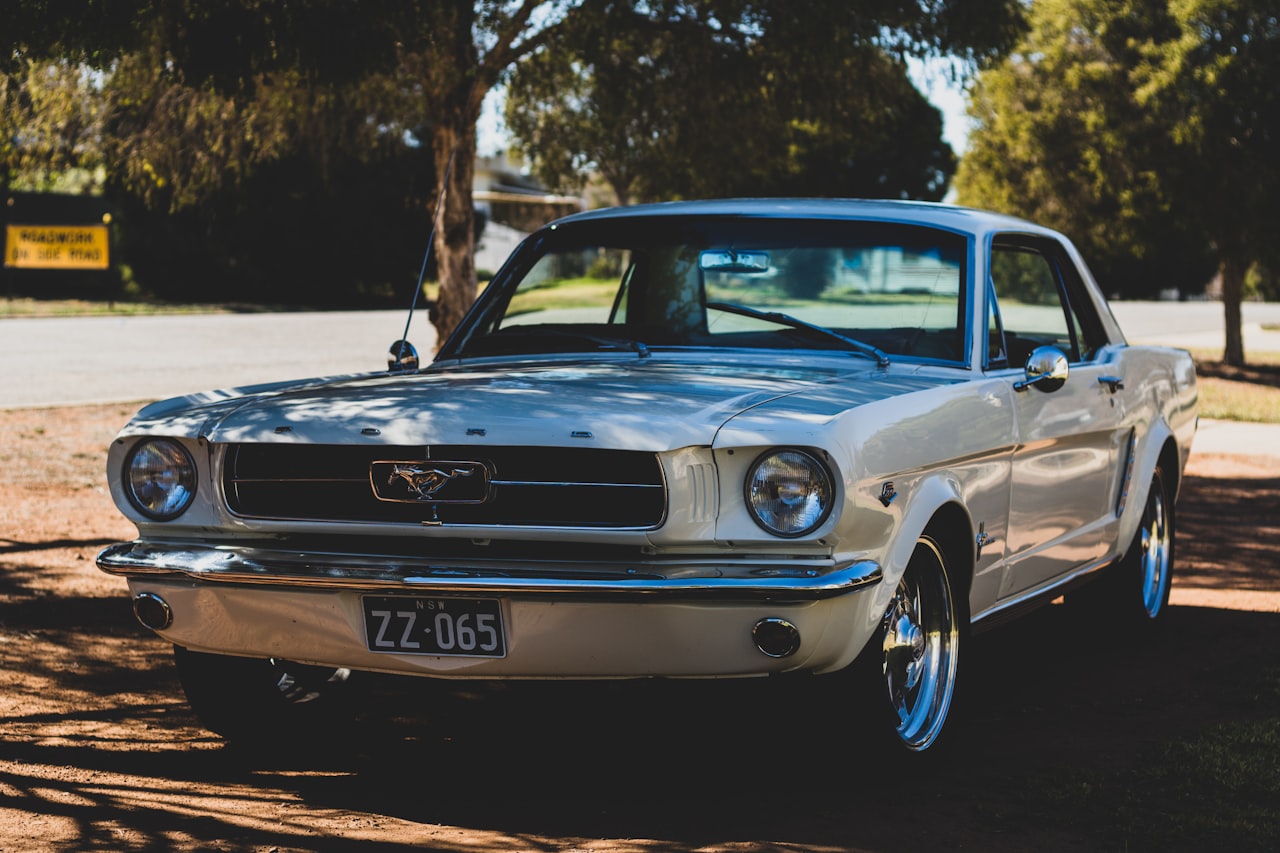
The Car
“We had a car that could be many things to many people.”
Lee Iacocca, on the Mustang’s market positioning, 1964The Ford Mustang went on sale on April 17, 1964 — simultaneously at the New York World’s Fair and at Ford dealers across America. It created a segment. Before the Mustang, there was no “pony car.” After it, every manufacturer scrambled to build one.
Lee Iacocca’s insight was deceptively simple: take a compact platform (the Falcon), dress it in sporty sheet metal, offer a long options list, and price it accessibly. The base Mustang debuted at $2,368 — less than a Corvette, less than a Thunderbird, less than almost anything that looked remotely exciting. In its first model year, Ford sold over 400,000 Mustangs. Nothing in American automotive history had moved like that.
The first-generation Mustang — produced from 1964½ through 1973 — came in three body styles: hardtop coupe, convertible, and the fastback (called the SportsRoof from 1969). It covered an extraordinary range of powertrain options, from frugal inline sixes through 289, 302, 351, 390, 427, and 428 cubic inch V8s. At its performance peak in 1969–70, the Mustang was available as a Boss 302 built for Trans-Am racing homologation, a Boss 429 built for NASCAR, a Mach 1 with the 428 Cobra Jet, and a Shelby GT500 with 335 horsepower from the factory — in a car that started life as an economy compact.
The restoration market for classic Mustangs is among the deepest in American automotive history. Parts reproduction began in the 1970s, earlier than almost any other marque, because demand was there from day one. Scott Drake has manufactured Mustang reproduction parts since 1967. The consequence, fifty years later, is an extraordinarily deep supply chain: virtually every component on a first-generation Mustang is available as quality reproduction, NOS, or reconditioned. The challenge is not whether a part exists — it is knowing which supplier to trust and which grade of part your restoration requires.
Can’t identify the part you need? Describe it in plain English, upload a photo, or paste a part number. CarSpanner identifies Mustang components from Ford engineering date codes, casting marks, and physical characteristics — including year-specific details like generator vs alternator specification and five-bolt vs four-bolt axle — and cross-references against the specialist suppliers most likely to stock it. Find a Mustang Part →

Not sure which Mustang variant you have? Describe your VIN, year, or any distinguishing features — and get an instant identification and parts sourcing recommendation.
Find Mustang parts →Year Groups
The first-generation Mustang spans ten model years and two fundamental body size changes. Parts sourcing depends on understanding which year group your car falls into — and often which specific production date, since Ford changed components mid-year without fanfare.
The original Mustangs, built on the Falcon platform. The 1964½ cars used a generator rather than an alternator, five-bolt wheels (changed to four-bolt in mid-1965), and an early instrument cluster with a distinctive face design. The alternator conversion happened in August 1964 with the start of full 1965 model year production. 1965 brought refinements across the range: the alternator, a new battery, revised dash details, and the introduction of the 271 bhp 289 High Performance (K-code) engine. 1966 was the last year for the five-bolt rear axle on some applications and introduced minor interior and exterior updates. These three years are the most collectible early Mustangs, and parts supply is comprehensive.
A wider, longer, more substantial body — the 1967 redesign was the first major rework of the Mustang’s sheet metal. The larger engine bay was critical: it could now accommodate the 390 FE big-block, and later the 427 and 428. Carroll Shelby’s GT350 and GT500 models were reborn on the ’67 platform, now built by A.O. Smith rather than Shelby’s Venice workshop. The 1968 model year brought the 428 Cobra Jet, one of the most underrated muscle car engines ever produced, and the California Special limited edition. Body parts for ’67–’68 are year-specific and largely don’t interchange with ’65–’66. Confirm the model year before ordering any sheet metal.
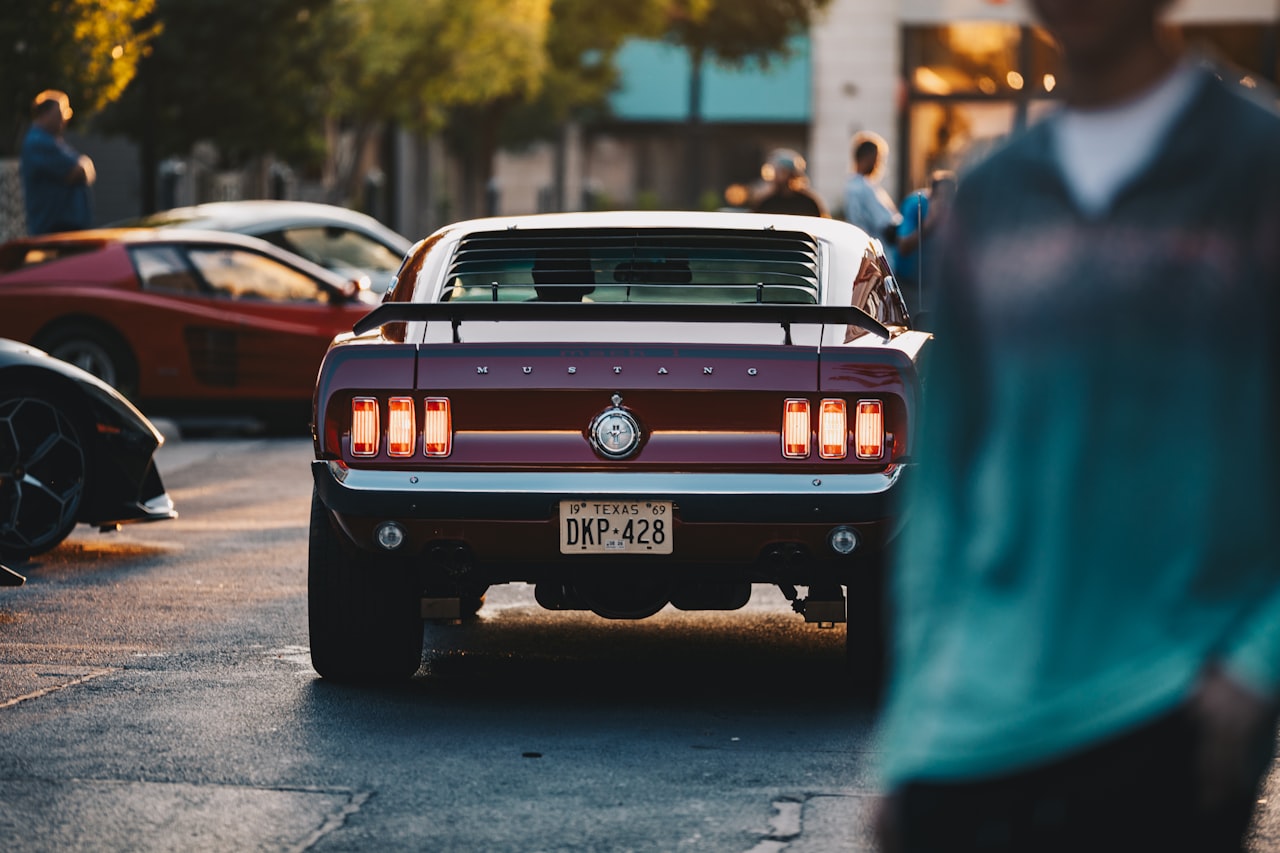
The Mustang reached its performance zenith in 1969–70. The Mach 1 SportsRoof (fastback) became the headline performer; the Boss 302 was built specifically for Trans-Am homologation with a high-revving small-block, revised heads, and a rev limiter; the Boss 429 required modified front suspension and a widened engine bay to accept the semi-hemispherical 429 engine built for NASCAR. The 428 Cobra Jet remained available across the range. The 1970 cars are largely a refinement of ’69, with distinctive dual colour-keyed sport mirrors and revised front end treatment. Boss-specific components are far less supported by the reproduction market than standard Mustang parts — they require specialist sourcing.
The 1971 Mustang grew again — longer, wider, and heavier than any previous generation car. The ’71 introduced the enormous 429 Super Cobra Jet at the top of the range. These are the least popular first-generation Mustangs with collectors: they are bigger, heavier, and less nimble than earlier cars, and the 1972–73 models bear the full weight of emissions equipment and reduced compression ratios. Parts reproduction is less comprehensive for these years than for ’64½–’70 cars, though the supply is improving. If your restoration target is a ’71–’73, budget extra time for parts sourcing and expect to rely more on NOS and used components for some trim items.
Parts Landscape
The classic Mustang benefits from the deepest parts supply chain of any American muscle car. The sheer production volume — over 1.2 million cars in the first generation — and the early start of the reproduction industry mean that most components are available from multiple sources. The challenge is quality, not availability.
Body Panels
Scott Drake is the reference standard for classic Mustang reproduction body panels. They have been manufacturing Mustang parts since 1967, and their panels are made to original specifications with correct gauge steel and accurate pressing. Classic Industries also carries a comprehensive Mustang panel range and is strong on both early and late first-generation cars.
The distinction that matters in practice is between quality reproduction panels and cheap pattern panels. Quality panels (Scott Drake, Classic Industries) are suitable for driver-quality and most show-quality restorations when professionally fitted. Cheap pattern panels — typically sold by low-price online vendors or under generic labels — are commonly manufactured from thinner-gauge steel with incorrect flange angles, wrong drainage holes, and misaligned mounting points. For the Mustang’s quarter panels in particular, where compound curves transition into the C-pillar and quarter window, cheap panels can be impossible to fit without result-defeating filler work. For structural panels — floor pans, torque boxes, frame rails — quality reproduction or NOS is non-negotiable. See our guide to OEM, NOS, and reproduction parts for a detailed breakdown of which grade suits which application.

Mechanical Components
The classic Mustang’s engines — 289, 302, 351 Windsor, 390, 427, and 428 — are among the most comprehensively supported engines in the American market. Summit Racing and JEGS are the primary sources for engine rebuild components: pistons, rings, bearings, gaskets, timing chains, camshafts, and carburettor rebuild kits. Both carry deep stock for the small-block 289/302 and 351W families.
The 289 High Performance (K-code, 271 bhp) requires specific internal components — the solid lifter camshaft, the high-rev valvetrain, and the distinctive exhaust manifolds — that are sourced through Mustang specialists rather than general suppliers. NPD and LMR both carry K-code specific items. FE big-block components (390, 427, 428) are served by specialist FE vendors and general performance suppliers; the 428 Cobra Jet is well supported given its racing heritage.
For drivetrain components — transmissions, rear axles, driveshafts — NPD and Classic Industries carry reproduction and NOS items alongside the mainstream performance suppliers. The Toploader four-speed and C4/C6 automatics are well served. For safety-critical components including brakes, suspension, and steering, always use quality reproduction or OEM/NOS — never pattern parts. For a complete guide to sourcing NOS for Mustang, see our NOS Parts — The Complete Guide.
Interior
Scott Drake and TMI Products are the primary interior suppliers for classic Mustangs. Scott Drake covers the full spectrum: carpet, door panels, headliners, instrument clusters, steering wheels, dash trim, and seat upholstery kits. TMI Products specialises in upholstery and is particularly strong on vinyl and leather reproductions — their seat covers are used by concours restorers and are made to the correct grain patterns and stitching specifications for each model year. NPD also carries a comprehensive interior range and is the first stop for many restorers sourcing multiple interior components in a single order.
Model-year specificity matters throughout the interior. Dashboard face designs changed between 1964½, 1965, 1966, and again with the 1967 redesign. Correct door panels, seat designs, and trim colours vary by year, body style, and option package. Always confirm your car’s specific model year, body style, and any relevant option codes (from the door tag or a Marti Report) before ordering interior components.
For a deep-dive on the second-hardest interior category — door panels, seat upholstery patterns, dash pads, headliners, carpet kits, and window sweeps, with year-specific notes for 1964½, early 1965, the 1967 split-year, 1969 Mach 1, and 1971–73 emission-era cars — see 1964–73 Mustang Interior — Hardest-to-Find Parts Guide.
For a deep-dive on the hardest-to-find date-coded sheet metal stampings and GT assemblies — VIN-stamped quarter panel blanks and Marti Report verification, fender and torque box stamping positions across the generations, frame rails, monte carlo bars, 1969 Mach 1 NACA hood, 1970 Boss 302 hood scoop, Shelby GT350/500 unique sheet metal (A.O. Smith vs Venice plant), and Boss 429 widened shock towers — see 1964–73 Ford Mustang Date-Coded Sheet Metal & GT Assemblies — Hardest-to-Find Parts Guide.
Supplier Directory
The following suppliers are the most consistently reliable sources for classic Mustang parts. This covers the range from comprehensive distributors through performance specialists and marketplaces for NOS hunting.
| Supplier | Speciality | Best For |
|---|---|---|
| NPD (National Parts Depot) | Comprehensive distributor for early Ford Mustang (and GM muscle car) parts. Body, mechanical, electrical, trim, and interior. Multiple US warehouse locations. | One-stop sourcing with deep stock and fast US shipping. Knowledgeable catalogue staff. First stop for most Mustang restorers. |
| Classic Industries | Sheet metal, mechanical, trim, and interior for classic Mustangs and GM muscle cars. Comprehensive catalogue indexed by year and model. | Broad range with competitive pricing. Strong on body panels and interior components. Good catalogue search by application. |
| Scott Drake | Manufacturer of Mustang reproduction parts since 1967. The name behind most quality Mustang reproductions across all categories. Scott Drake parts are stocked by NPD and many other distributors. | Reference-quality reproduction parts. If a component carries the Scott Drake name, it meets the standard most serious restorers accept. Covers ’64½–’73. |
| LMR (Late Model Restoration) | Classic Mustang specialist with a strong technical resource library alongside parts supply. Covers ’64½–’73 comprehensively, with particularly strong coverage of less-common variants. | Expert guidance alongside parts. Technical articles and how-to videos make LMR a strong resource for less common parts identification and fitment questions. |
| Shelby American / SAAC | Shelby GT350 and GT500 specific components. The Shelby American Automobile Club (SAAC) community connects buyers with verified Shelby-specific parts vendors. | Shelby-specific sheet metal, trim, drivetrain components, and documentation. Essential for any GT350 or GT500 restoration requiring correct Shelby parts rather than standard Mustang parts. |
| Boss 429 Registry | Registry of original Boss 429 stampings — recovered NOS inner fenders and dimensional verification for authenticity. | Boss 429 specific sheet metal stampings (inner fenders, shock tower caps), authenticity verification for any candidate panel, and the community referral path to owners who parted-out original 429 cars. |
| Summit Racing | Performance and engine components for all American V8s including the 289, 302, 351W, 390, 427, and 428 families. Comprehensive carburettor, ignition, and intake range. | Engine rebuilds and performance upgrades. Carburettor rebuilds and replacements. Ignition systems. Exhaust. Fast shipping from multiple warehouse locations. |
| Hemmings | Classifieds and marketplace for NOS, used, and rare Mustang parts. The longest-running classic car parts marketplace in the United States. | NOS parts hunting. Date-coded components. Rare trim and body items. Donor cars and parts cars. Always verify seller reputation and part authenticity before purchasing. |
For any Mustang part you cannot identify or locate, ask CarSpanner. Describe the part, upload a photo, or share your VIN — we will point you to the right supplier and the right specification for your specific car and year.
For any Mustang part you are unsure about — describe what you need, share your VIN or year, and we will point you to the right supplier and the right specification.
Ask about your Mustang →Common Challenges
The classic Mustang’s restoration market is mature, but two challenges recur across nearly every serious restoration. Knowing about them before you start saves money and frustration.
Date-Coded Components
Mustangs built for concours or numbers-matching restoration require date-coded components: alternators, carburettors, distributors, voltage regulators, water pumps, and other mechanical and electrical parts were stamped with build dates at the factory. In a correct restoration, each component’s date code must precede the car’s assembly date. Locating correctly date-coded components is one of the most time-consuming aspects of a high-points Mustang Club of America (MCA) judged restoration — especially for rarer variants where production numbers were low. The Marti Report, produced from Ford’s original production records by Marti Auto Works using your VIN, is the essential document for establishing your car’s original specifications and therefore the required date range for its components. Without a Marti Report, you are guessing. With one, you know exactly what you’re looking for. For date-coded components themselves, the MCA and SAAC communities, Hemmings classifieds, and specialist marque swap meets are the most reliable hunting grounds. For a step-by-step guide to identifying and verifying date-coded components, see Identifying Original Date-Coded Components on a Ford Mustang.
Quarter Panel Fitment
The classic Mustang’s quarter panels — particularly on fastback and SportsRoof cars — are among the most fitment-critical panels in American classic car restoration. The compound curves and the C-pillar transition are difficult to form correctly, and the gap to the quarter window must be consistent and even. Even quality reproduction panels from Scott Drake or Classic Industries require professional fitting and finishing work to achieve acceptable gaps. Cheap pattern panels make this dramatically worse: incorrect flange angles mean the panel sits wrong before you even begin bodywork, incorrect drainage holes allow moisture ingress, and thin-gauge steel does not respond well to the stretching and shrinking required to achieve correct alignment. The result of fitting cheap quarter panels is often a car that looks obviously wrong — uneven gaps, a floating C-pillar, water in the trunk. Buy quality panels, budget for professional fitting, and expect the fitting labour to equal or exceed the panel cost on fastback cars.