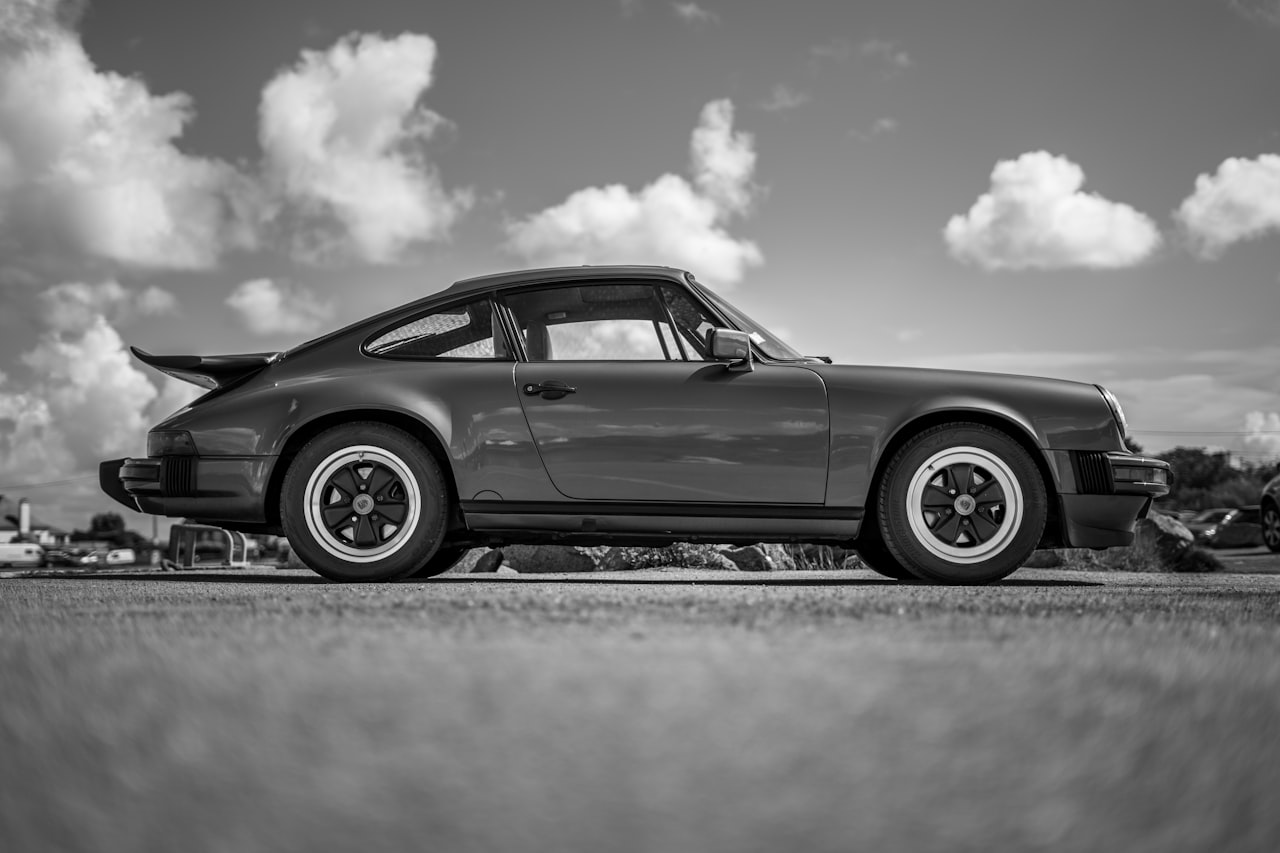
The Marque
“The 911 is the only car you could drive on an African safari, at Le Mans, on the streets of Paris, and to the theatre.”
Ferry PorscheThe Porsche 911 was not supposed to exist. The 356 was Porsche's original car — a rear-engined, air-cooled sports car built partly from Volkswagen components, designed by Ferry Porsche after the Second World War. It was successful, but it was ageing. By the early 1960s, Ferry Porsche and his son Butzi set out to design a successor that would be more capable, more refined, and more contemporary. The car that became the 911 was shown at the Frankfurt Motor Show in September 1963 and went on sale in 1964.
The original designation was 901 — until Peugeot pointed out their trademark on three-digit numbers with a zero in the middle. Porsche changed the name to 911 and the designation 901 survived only as the name of the first gearbox. The engine was a new 2.0-litre air-cooled flat-six of Ferdinand Piëch's design, producing 130 bhp. Air cooling had defined the 356; it would define the 911 for its entire thirty-year production run.
What followed was a story of continuous development rather than clean-sheet redesign. Porsche enlarged the engine incrementally from 2.0 litres through 2.2, 2.4, 2.7, 3.0, and eventually 3.6 litres on the 964. They added turbocharging with the 930 in 1975. They introduced full galvanisation in 1976 to address the corrosion problems that had damaged early cars. They changed the gearbox, the suspension geometry, the fuel delivery system, and the brakes — all while maintaining the rear-engined, air-cooled configuration that had been there from the start.
The 964 of 1989 was the most significant reworking of the formula: coil spring suspension replaced the torsion bars, ABS and power steering became standard, and the engine was enlarged to 3.6 litres with twin-plug ignition. It was still recognisably a 911. The water-cooled 996 that arrived in 1997 was the genuine break — which is why the air-cooled era is defined so precisely. If you own a 911 made between 1964 and 1994, you own something built around a philosophy that Porsche maintained for three decades and then deliberately ended.
Can’t identify the part you need? Describe it in plain English, upload a photo, or paste a part number. CarSpanner identifies Porsche 911 components from engine number matching, Porsche casting numbers and date codes, and air-cooled specific details — and cross-references against the specialist suppliers most likely to stock it. Find a Porsche 911 Part →

Hunting a rare 911 part — a cylinder head, a specific gearbox ratio, or a NOS trim piece? Describe what you need and Geoff will check every current source.
Ask about your 911 →Model Generations
Thirty years of continuous production produces a complicated model history. The guide below covers the key generations and their significance for parts sourcing.
The original 911 with its longer front overhang before the 1974 impact bumper revision. Within this era: the 911S (high-performance, Weber carburettors, 160 bhp from 1967), the 911T (economy variant, lower compression), and the 911E (mid-range with Bosch mechanical fuel injection from 1969). The Carrera RS 2.7 (1972–73) is the landmark model of this era — a homologation special using a 2.7-litre MFI engine, ducktail spoiler, and lightweight construction. The 901 gearbox (dog-leg first) is specific to the earliest cars; the 915 gearbox replaced it from 1972. Long-hood cars command significant premiums and parts are increasingly difficult to source.
The 1974 model year introduced the G-body with accordion-style impact bumpers to meet US federal standards. The 2.7-litre engine became standard across the range. The Carrera variant used a 2.7 MFI engine producing 210 bhp; the base model used a CIS (Bosch K-Jetronic) injection system on higher-spec cars, or the Zenith carburettor on the 911 base model. Galvanisation from 1976 transformed the body durability of cars from this point onward. The 915 gearbox was standard throughout. The 1974–75 cars are the last of the ungalvanised G-bodies and must be inspected carefully for corrosion.
The 930 Turbo arrived in 1975 with a 3.0-litre turbocharged flat-six producing 260 bhp, wide rear arches, a whale-tail spoiler, and a reputation for snap oversteer that killed several owners unfamiliar with its dynamics. It is the most visually dramatic air-cooled 911 of the period. The engine grew to 3.3 litres in 1978, gaining an intercooler. Turbo-specific parts — the intercooler, the turbo itself, the Bosch injection components, the wide-body panels — are specialist items. The 3.0 Turbo is increasingly collectible; the 3.3 Turbo is more practical. Both require specialist knowledge for correct maintenance and parts sourcing.
The 3.2 Carrera is considered by many the most balanced and liveable air-cooled 911 — 231 bhp from 3.2 litres, the Bosch Motronic DME (digital engine management), and the revised G50 gearbox from 1987 replacing the older 915. The G50 is a significantly stronger unit with a conventional shift pattern; 3.2 Carreras with the G50 are preferred over the earlier 915-gearbox cars by most buyers. The Motronic injection system is well understood and parts are available. The 3.2 Carrera Cabriolet and Targa are particularly sought-after. This generation benefits from full galvanisation and is generally the most corrosion-resistant of the pre-964 cars.
The 964 was an 85% new car: coil spring suspension (replacing the torsion bars of all previous 911s), ABS as standard, power-assisted steering, and a 3.6-litre engine with twin-plug ignition producing 250 bhp. It was available as Carrera 2 (rear-wheel drive), Carrera 4 (four-wheel drive), Turbo, RS, and RS America. The Nikasil cylinder bore issue affects some examples (see Parts Challenges below). The 964 RS is the lightweight homologation variant — extremely collectible and correct-specification parts are priced accordingly. The 964 Turbo 3.6 (1992–94) is the rarest and most powerful of the air-cooled Turbos.
Parts Challenges by System
The air-cooled 911 has a well-developed parts supply, but several areas are genuinely difficult. Here is an honest account of where the challenges lie.
Engine — Cylinder Heads, Barrels, and Timing
The air-cooled flat-six is a fundamentally robust engine when maintained correctly. The most significant challenges are:
Cylinder heads and barrels for early cars (2.0 to 2.4 litre) are NLA from Porsche and sourced from NOS stock, good used parts, or specialists offering reconditioning. Mahle supplies new pistons and cylinders for most air-cooled engines and is the standard specification for a rebuild — confirm the correct bore size for your engine variant before ordering.
Nikasil bores on the 964 require individual assessment: a compression test and borescope inspection are essential on any 964 purchase. Affected engines need cylinder replacement; the cost is significant but the job is well-understood by 964 specialists.
Timing chain tensioners on pre-1984 cars are a known maintenance item. The chain and tensioner should be inspected at every major service. Uprated tensioners (the revised flat spring design) are available and are the correct specification for any engine rebuild on these cars. Do not run a pre-1984 911 hard from cold. For UK air-cooled 911 mechanical expertise including timing chain service, valve adjustments, and tuning — particularly engine rebuild work on early 2.0–2.4-litre units — Design 911 is the long-established UK 911 specialist.
Bosch mechanical fuel injection (MFI) on the Carrera RS 2.7 and early E-series cars is specialist work. The injection pump requires periodic overhaul and calibration; sourcing is from Porsche specialists rather than general suppliers. For US air-cooled owners needing complete engine rebuilds, body panels, or full kits sourced to concours specification — including correct-date-coded components and concours-grade finishes — Stoddard is the long-established US specialist with particular depth on numbers-matching restorations.
Transmission — 901, 915, G50, and Sportomatic
901 gearbox (1964–1971): Rebuild parts are scarce. Internal gears, synchromesh rings, and bearing sets are sourced from NOS stock or from specialists who maintain rebuild kits. The dog-leg shift pattern is distinctive and either loved or disliked. If you are buying a car with a 901 gearbox and it has issues, budget for a specialist rebuild rather than a parts-bin repair.
915 gearbox (1972–1986): Better supported than the 901. Synchromesh components for second and third gear are the most common wear items — these gears are used heavily in normal driving and the synchro rings wear. Rebuild kits are available from Pelican Parts and specialist suppliers. A 915 that crunches into second is a common finding on unrestored cars; it is a known fault with a known fix.
G50 gearbox (1987 onwards on 3.2 Carrera, standard on 964): More robust than the 915 and better parts availability. A significant engineering improvement.
Sportomatic: Porsche's semi-automatic option, available from 1967 to 1979, used a torque converter with an automatic clutch triggered by touching the gear lever. Parts are now genuinely difficult to source — the torque converter, hydraulic control unit, and centrifugal clutch components are not reproduced. Most restorers convert Sportomatics to manual or work with one of the small number of remaining specialists. If you are buying a Sportomatic car with a non-functioning transmission, price the conversion into your offer.
Interior — Seats, Door Cards, and Headliners
Correct-period interior parts for the air-cooled 911 are a significant sourcing challenge, particularly for the early cars. Original seats in correct-period specifications — the correct fabric or leather, the correct trim level for the model year — are found through specialist classifieds and the Rennlist marketplace rather than from suppliers. Repro seat covers are available but matching original specifications requires research.
Door panels for early cars are reproduced by specialists including Porsche suppliers in Germany and by North American specialists such as Stoddard. Confirm the model year and door configuration before ordering — the door panel design changed across the production run.
Headliners for Coupes and Targas are available from upholstery specialists. The Targa roll bar trim is a specific item that can be difficult to source in original specification.
For a concours-quality restoration, the correct specification must be researched through the build card (available from Porsche Museum) or through the relevant club — correct-period interior parts matter significantly to judges and buyers of numbers-correct cars.
Electrical — CDI Ignition, Instruments, and Lighting
CDI (capacitor discharge ignition) boxes on earlier cars are a known failure point. The original Bosch and Marelli CDI units fail over time as the capacitors age and the potting compound degrades. Rebuilt units are available from specialists; new reproduction units are made by Pertronix and others. A 911 that runs well when cold but cuts out when warm often has a failing CDI box.
Instrument clusters for early cars are NLA from Porsche; sourced from NOS stock, from the Rennlist and Pelican Parts classifieds, or from specialist instrument rebuilders in Germany. The VDO instruments used throughout most of the air-cooled production run are rebuildable if the mechanics are sound; specialist rebuilders can restore function and appearance.
Headlight assemblies for early cars (sealed beams on US-market cars, European H4 units on RoW spec) are available from lighting specialists and from Porsche parts suppliers. Correct-specification early headlight pods and their chrome surrounds are sourced through specialist classifieds for numbers-correct restorations.
Body Corrosion Hotspots
The air-cooled 911's corrosion history divides cleanly at 1976 — the year Porsche introduced full zinc galvanisation. Pre-1976 cars rust. Post-1976 cars hold up considerably better. Here is where to look. For genuine OEM body panels — including original-specification front panels, rear body sections, and structural panels with correct Porsche part numbers — Porsche Classic (the official Porsche Classic & Collectibility programme) supplies the same genuine components that built the cars originally.
Kidney Panels (Pre-1976 Critical; Post-1976 Less So)
The kidney panels — the curved body sections immediately behind the rear wheels, above the engine cover — are the single most important corrosion check on any pre-1976 911. These panels are structural: they form part of the body shell and their failure is not a cosmetic issue. Probe the kidney panels with a screwdriver on any pre-1976 purchase. Replacement kidney panels are available from Restoration Design (USA) and other specialists; they are expensive and the repair is a significant body restoration job. A car with sound kidneys is worth meaningfully more than one requiring panel replacement.
Battery Box and Front Luggage Compartment Floor
The battery box, located in the front luggage compartment, is a reliable corrosion point on all pre-1976 cars and on post-1976 cars that have had a leaking battery or neglected drains. Battery acid accelerates corrosion dramatically; a battery that has leaked and been left can produce extensive floor damage around the mounting area. Lift the front compartment carpet on any purchase and inspect carefully. The front floor section is available as a repair panel from Restoration Design and from Paragon Products. The repair is fiddly but manageable for a competent bodyshop.
Door Bottoms and Rocker Panels
The lower edge of each door and the rocker panel (sill) beneath the door opening are common rust points on pre-1976 cars. Door bottom repair sections are available from body panel specialists. The rocker panel sits above the lower sill area and its condition is a reasonable indicator of how the rest of the body has been maintained. Rust here on a post-1976 car indicates either an accident repair that was poorly done or a failure of the galvanised coating — both worth investigating further.
Front Suspension Towers
On very early cars (pre-1969) and on cars that have had front-end accident damage, the front suspension towers can corrode at their bases where they meet the floor. This is structural and repair is specialist work. Inspect carefully on long-hood cars before purchase. Later G-body cars are less susceptible here but still worth checking on any car with a history of front impact.
Rear Quarter Windows and Screen Seals
The rubber seals around the rear quarter windows and the windscreen allow water ingress on aged cars, leading to corrosion in the surrounding flanges and the carpet-covered floor sections beneath. Replacement seal rubbers are available from Porsche suppliers; fitting them correctly is important. Any 911 with damp carpets at purchase should be fully stripped to assess the extent of water damage — moisture under carpet causes far more damage than the surface suggests.
OEM vs Reproduction — Quality Guidance
The air-cooled 911 parts market spans genuine Porsche OEM, quality reproduction, and pattern parts of variable quality. Here is the guidance that matters.
Safety-Critical Components: OEM or Quality Reproduction Only
For brakes, suspension, and fuel system components, do not use unknown pattern parts. Brake master cylinders, calipers, brake lines, wheel bearings, suspension ball joints, and tie rod ends must be sourced from Porsche (OEM), ATE, Ate, Brembo, or a reputable specialist supplier. The consequences of substandard components in these systems are serious. Pelican Parts and Stoddard both supply quality reproduction or OEM-equivalent hardware for these items. When in doubt, spend more and be certain.
Engine Components: Mahle is the OEM Standard
For piston and cylinder sets on air-cooled 911 engines, Mahle is the OEM supplier and the correct specification for any rebuild. Confirm the bore size and compression ratio for your specific engine before ordering — these varied across the model range and year. Porsche engine gasket sets are available from suppliers including Elring and Victor Reinz, both of which supply OEM-quality materials. Do not use the cheapest available gasket kit on an air-cooled flat-six rebuild.
Body Panels: Quality Varies Significantly
Restoration Design (USA) is generally considered the benchmark for air-cooled 911 structural panels — kidney sections, floor pans, battery box repair panels. Their panels are more expensive than pattern alternatives but have significantly better fitment and material quality. For cosmetic panels (wings, bumpers, bonnet), the quality range is wide. Ask the supplier which manufacturer the panels come from before ordering. Known-poor fitment on 911 wings is a common complaint from restorers who bought on price.
NOS (New Old Stock): Premium But Often Correct
For early cars where Porsche OEM parts are no longer available, genuine NOS parts are the correct solution for a numbers-correct restoration. The Sierra Madre Collection and similar NOS specialists maintain extensive inventories of early Porsche parts. Rennlist and the PCA classifieds are also consistent sources. NOS parts command significant premiums — confirm authenticity through Porsche part numbers and known-good suppliers before paying NOS prices for reproduction items.
Describe what you need — a part number, a description, or even just "something that does X" — and Geoff will check every current supplier source.
Ask about your 911 →Part Number Cross-References
Air-cooled 911 parts are cross-referenced across Porsche OEM numbers, Bosch, Mahle, and VDO. The following guidance applies when sourcing common components.
Bosch Components
Ignition: Bosch supplied the ignition system across most of the air-cooled range. Distributor caps, rotors, points (pre-electronic), and the CDI units all carry Bosch part numbers. Cross-reference the Bosch number against your car's VIN and engine number through a Porsche parts supplier to confirm the correct specification. Common Bosch components: fuel injectors for the K-Jetronic and L-Jetronic systems are Bosch items available from injection specialists; the fuel accumulator and pressure regulator are Bosch parts that can be sourced by Bosch part number through fuel injection specialists independently of Porsche pricing.
Mahle Components
Mahle is the OEM supplier for pistons, cylinders, and piston rings on the air-cooled flat-six. Mahle part numbers for piston/cylinder sets are cross-referenced against the Porsche engine type designation (901, 911, 930, etc.) and displacement. When ordering a piston/cylinder set from a supplier such as Pelican Parts or Stoddard, confirm the Porsche engine type code and the bore size to receive the correct Mahle specification. Mahle also supplies oil filters — the Mahle OX 90 family covers most air-cooled applications.
VDO Instruments
The instrument cluster across most of the air-cooled 911 range used VDO instruments. Speedometers, rev counters, oil temperature, and fuel gauges are all VDO items. VDO part numbers for 911 instruments are documented in the Porsche workshop manual and cross-referenced in the Porsche parts microfiche (available through PCA and Rennlist resources). VDO instruments can be rebuilt if the mechanics are sound — specialist instrument rebuilders in Germany and the USA restore both function and original appearance. Replacement VDO instruments sourced through Pelican Parts or the Rennlist classifieds should be verified against the model year specification before purchase.
Specialist Suppliers
These are the suppliers that the air-cooled 911 community consistently relies on. For North American buyers, Pelican Parts is typically the first stop; Stoddard for correctness-critical items.
| Supplier | Location | Strengths | Best For |
|---|---|---|---|
| Pelican Parts Primary US | California, USA | Largest US online Porsche specialist. Enormous catalogue covering all air-cooled models. Well-known DIY technical guides. Competitive pricing and strong stock levels. | First stop for most 911 parts from the USA. Excellent for mechanical components, consumables, engine parts, and general restoration hardware. Strong on 964 and 3.2 Carrera parts. |
| Stoddard Porsche NOS & Correct Spec | Ohio, USA | Specialist in NOS and quality reproduction parts for air-cooled Porsche. Strong emphasis on correctness for concours and numbers-matching restorations. Long-established reputation. | Concours and numbers-correct restorations. Early long-hood cars where OEM parts are NLA. Buyers willing to pay for verified correct specification. |
| Restoration Design Body Panels | USA | The benchmark supplier for structural body panels on air-cooled 911s. Kidney sections, floor pans, battery box panels, and other structural items are made to high quality standards with good fitment. | Any 911 body restoration requiring structural panels. Kidney panel replacement, front floor and battery box repair, and related structural sheet metal. |
| Zims Autotechnik Established US Specialist | Texas, USA | Long-established air-cooled Porsche specialist with broad coverage across all models. Strong on mechanical parts and general restoration hardware. Well-regarded customer service. | Alternative US source to Pelican with good coverage across the air-cooled range. Particularly useful for older model parts and hard-to-find items. |
| Paragon Products Interior & Body | California, USA | Strong on interior trim, upholstery, and body panel items. Quality reputation for seat covers, carpet sets, and interior components. Good coverage of hard-top and soft-top items. | Interior restoration. Seat cover sets, carpet sets, door panels, and soft-top/hard-top items for the full air-cooled range. |
| Sierra Madre Collection NOS Specialist | California, USA | Specialist inventory of NOS Porsche parts, particularly for early air-cooled models. Sourced from dealer old stock and estate collections. Verified original Porsche parts. | Numbers-correct and concours restorations requiring genuine NOS items. Early 911 parts that are no longer available from any other source. |
| Demon Tweeks UK/Europe | Wrexham, UK | UK motorsport and classic car specialist with a Porsche range. Useful for UK and European buyers seeking a domestic source. Carries performance and OEM-equivalent items. | UK-based buyers seeking domestic supply for consumables, performance parts, and general maintenance items. Competitive on tyres, brakes, and suspension components. |
For any air-cooled 911 part where you are unsure of the correct specification for your model year and engine type, ask CarSpanner. Describe the car, the engine type code, and the component needed — we will identify the correct specification and the best current source.
Parts Sourcing Guide
For a complete parts sourcing guide — engine barrel and piston sets, gearbox families (901, 915, G50), body panel sourcing, interior trim, supplier pricing expectations, and what to buy new versus reproduction — see the dedicated Porsche 911 Air-Cooled Parts Guide. The sections above cover the marque in full; that guide covers the sourcing in detail.
Community Resources
The air-cooled 911 community is one of the most technically thorough in the classic car world. These are the resources worth engaging with.
Porsche Club of America (PCA)
The PCA is the largest Porsche club in the world, with over 140 regional clubs and more than 100,000 members. For US-based 911 owners, PCA membership provides access to technical resources, driver education events, and the Porsche Panorama magazine. The PCA's technical forum and the Rennlist forum (below) together represent the most comprehensive publicly accessible knowledge base on 911 maintenance and restoration. Regional clubs run everything from casual drives to concours events. PCA's Club Racing programme is accessible to members with 911s of all generations.
Rennlist
Rennlist is the primary English-language online forum for Porsche owners. It is model-specific, well-moderated, and technically detailed. The air-cooled sub-forums cover everything from basic maintenance to full restoration. Before approaching a specialist with a 911 problem, search Rennlist first — there is a very high probability that someone has already encountered, documented, and solved the same issue. The Rennlist marketplace is also a consistent source for specialist parts, NOS items, and cars. Create an account; the level of technical knowledge available is extraordinary.
Pelican Parts Technical Forum
Pelican Parts maintains an active technical forum alongside their parts business. The Porsche section is well-organised and the illustrated technical guides — covering everything from oil changes to engine rebuilds — are among the best free resources available for 911 owners. Pelican's guides are step-by-step with photographs and are particularly useful for owners tackling DIY maintenance for the first time on an air-cooled car. The forum has a searchable archive of significant depth.
911 Registry
The 911 Registry maintains production records and chassis documentation for air-cooled 911s. For a numbers-correct restoration or a pre-purchase history verification, the Registry is the reference point. The VIN database allows cross-referencing of chassis numbers against build records, which is particularly valuable when assessing early cars where the build card has been lost. Membership provides access to the registry database and the collective documentation maintained by the club.
Porsche Club Great Britain (PCGB)
For UK-based owners, the Porsche Club Great Britain provides the same community and concours infrastructure as PCA. Regional centres, driving events, technical expertise, and the Porsche Post magazine. The PCGB concours programme is particularly strong — the judging standards for air-cooled cars are well-documented and the pre-concours preparation advice from experienced club members is invaluable for anyone preparing a car seriously.