The Marque
“The last real Triumph.”
The consensus among TR owners who drove what came afterThe Triumph TR series began in 1953 as an afterthought. The TR1 prototype shown at the London Motor Show was considered too rough for production, but public enthusiasm forced Triumph's hand. The TR2 that followed in 1953 was a genuine sports car — fast, affordable, and built for an export market that desperately wanted a British alternative to the MG TD. What followed was a two-decade lineage that ran through the TR3, TR4, TR5, and culminated in the TR6.
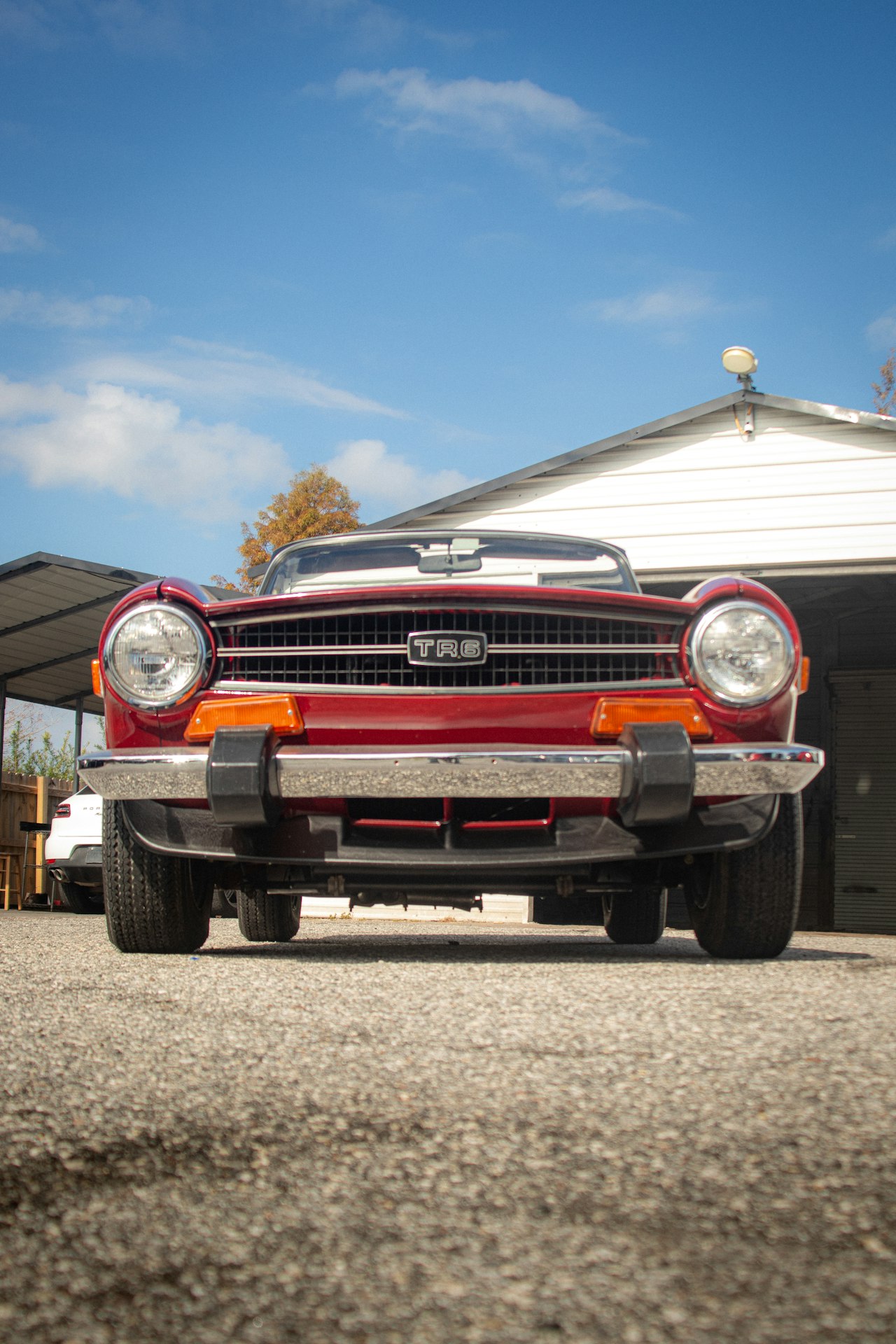
The TR6 arrived in late 1968 and was immediately recognisable as something different. Where the TR5 had carried Michelotti's flowing Italian lines, the TR6 wore a crisper, more angular body restyled by Karmann of Osnabrück. The transformation was significant enough that the TR6 reads as a different car at a glance, yet underneath it shared the TR5's floorpan, inner body structure, and doors. Triumph got a new-looking car for the cost of restyling the front and rear sections. Whether that frugality served the car well depends on what you value; the TR6 remains the best-looking of the TR series to many eyes.
The engine was the 2498cc straight-six shared with the Triumph Vitesse and GT6, developing 150bhp in Lucas Petrol Injection form on UK-market cars and, in heavily emissions-detuned guise, as little as 104bhp on late US-market cars. It is an engine of genuine character — torquey, smooth for its era, and possessed of a distinctive exhaust note. Over 94,000 TR6s were produced between 1969 and 1976, making it the best-selling TR in the marque's history. The vast majority went to the United States.
Triumph's ownership passed to British Leyland during the TR6's production run, a transition that would eventually kill the traditional roadster format entirely. The TR7 that replaced it in 1975 was a different kind of car — wedge-shaped, front-engined, and fundamentally a product of committee compromise. The TR6 has aged rather better.
Can’t identify the part you need? Describe it in plain English, upload a photo, or paste a part number. CarSpanner identifies Triumph TR6 components from casting marks, part numbers, physical characteristics, and vehicle context — and cross-references against the specialist suppliers most likely to stock it. Find a TR6 Part →

Not sure which TR6 variant you have? Describe your commission number, PI vs carburettor specification, or any distinguishing features — and get an instant identification and parts sourcing recommendation.
Find TR6 parts →Variants & Specification
Understanding which TR6 you have — or are buying — matters more than it does with many other classics. The PI versus carburettor distinction is significant, and the commission number prefix tells you immediately which side of the line the car falls on.
The original UK-market TR6 used the Lucas Petrol Injection system inherited from the TR5. The mechanical injection pump (metering unit) delivers fuel at high pressure to injectors at each inlet port, producing 150bhp. The PI cars are the most powerful production TR6s and the most complex. Commission numbers carry the CC prefix. Parts for the PI system — particularly the metering unit and pressure relief valve — require specialist sourcing. These are the purist choice; they are also the most demanding to maintain correctly.
From 1973, UK-market cars switched to twin Zenith-Stromberg 175 CD carburettors, reducing output to 125bhp. The CR prefix identifies these cars. The transition was partly driven by emissions concerns and partly by the cost of maintaining the PI system in service. CR cars are mechanically simpler and arguably more practical for everyday use. They carry the same body, interior, and running gear as the PI cars. Overdrive was available as an option throughout. CR cars are more straightforward to maintain and parts are more readily available.
All US-market TR6s used twin Zenith-Stromberg carburettors throughout production. Federal emissions regulations progressively reduced power output: from 104bhp in 1970 to 106bhp by 1975. US cars received rubber-faced bumper overriders from 1974 to meet impact standards, and side reflectors are standard fitments absent on UK cars. Despite the power reduction, US TR6s are structurally identical to UK examples and benefit from the same strong parts supply. The CF commission prefix identifies US-specification cars. These are the most numerous TR6s in existence.
The Laycock J-type overdrive is one of the most sought-after TR6 options. Operating on third and fourth gears, it reduces engine speed significantly at motorway and highway cruising speeds, making the TR6 a genuinely comfortable long-distance car. Overdrive-equipped TR6s command a premium on the market and are considerably more pleasant to drive on modern roads. The most common fault is relay failure, which is a simple and inexpensive repair. If you are buying a TR6 without overdrive, retro-fitting it is possible if the gearbox tunnel is pre-drilled for the gear selection switch — many were.
Body Corrosion Hotspots
The TR6 is a product of its era: steel construction, minimal rust-proofing from the factory, and a design that traps water in several predictable locations. Every TR6 that has not been fully restored will have corrosion. The question is always where and how severe.
Sills
The sills are the structural heart of the TR6 body. The inner sill is a load-bearing structural member; the outer sill is a cosmetic panel over it. Both rot. Sill failure is the most serious structural problem on a TR6 and the most common finding on unrestored cars. Water enters from above through the door seals and from below through road splash. Proper sill repair requires removing the door and outer panel to assess the inner sill condition — an outer sill patch over a rotten inner is cosmetic fraud. Replacement sill sections are available from all main suppliers. The repair is significant but entirely manageable for a competent bodyshop.
Floor Pans
The floor pans on a TR6 corrode where water sits — under the carpets, around the drain plugs, and at the seams where the floor meets the inner sill. The passenger side is often worse than the driver’s side, as the transmission tunnel and seat mounting points create channels that hold water. Tap the floor pans with a rubber mallet; a hollow note or soft patch indicates rot. Full floor pan replacement panels are available; partial repair sections are also stocked. Deal with floor pans before fitting new carpets — laying carpet over damp steel is an accelerant.
Chassis Outriggers & Cruciform
The TR6 box-section chassis uses outriggers to support the body at the sill mounting points and a central cruciform for torsional stiffness. The outriggers are the first casualty of corrosion — they collect mud and retain moisture, and their failure affects body mounting integrity. Probe every outrigger with a screwdriver before purchasing any TR6. The cruciform sections corrode at the welds and at the base of the upswept rear section where it meets the rear bodywork. Replacement outrigger sections and repair patches are available; a full chassis replacement is the appropriate response to widespread cruciform damage.
Front Valance & A-Post Bases
The front valance panel traps mud and water between itself and the inner wing. The base of the A-post — where the door pillar meets the inner sill and front wing closing panel — is another reliable corrosion point. Both are repairable with available panel sections, but the work requires careful preparation: rust left behind a repaired panel will return within years. Strip to bare metal, treat, and seal before any filler or paint work.
Boot Floor & Spare Wheel Well
The boot floor on a TR6 is prone to corrosion at the spare wheel well and at the rear seam where the floor meets the rear panel. Water enters through aged boot seal rubber and the spare wheel mounting point. A rotten boot floor is not structural in the way that sills are, but it is a reasonable indicator of how the rest of the car has been maintained. Boot floor panels are available. The hood (soft top) mechanism mounting points in the boot are worth inspecting for distortion or rust that would complicate a hood replacement.
Parts Categories
TR6 parts supply is among the best-supported in the British classic car world. The volume produced, the dedicated club infrastructure, and the active US market have kept specialist suppliers viable for over fifty years. Here is what to expect by category.
Body Panels & Repair Sections
Outer body panels — wings, bonnet, doors, valances — are available as new pressings from the major TR specialists. Quality varies between manufacturers: ask the suppliers which panels they stock by origin, since some reproductions have fitment issues that require adjustment. Sill sections (inner and outer), floor pans, outrigger repair sections, and boot floors are all available as repair panels. For cosmetically acceptable used original panels, TR Register spares schemes and club classifieds are good sources. Panel quality from Rimmer Bros and Moss Motors reproduction pressings is generally reliable.
Engine — 2498cc Straight-Six
The 2.5-litre straight-six is a well-supported engine. Rebuild kits (pistons, bearings, gaskets, timing components) are available from all main suppliers. The engine shares architecture with the Triumph Vitesse and GT6, which extends the parts base. Head gasket failures are the most common engine issue on cars that have been overheated or have had coolant neglected. The cylinder head can crack between the valve seats on severely overheated examples — a professional pressure test before any TR6 purchase is advisable. Oil leaks from the rocker cover and timing cover are universal on high-mileage engines and are solved with standard gasket kits.
Lucas Petrol Injection (PI) System
The Lucas PI system on CC-prefix cars requires specialist knowledge and parts that are distinct from the carburettor cars. The critical components are the metering unit (the mechanical injection pump), the pressure relief valve (PRV), and the high-pressure fuel lines. The metering unit requires periodic overhaul and is the most expensive single item in the system to repair or replace. Revington TR is the primary specialist for PI system components and rebuilding. The system delivers significantly better performance than the later carburettor setup, but it demands respect — high fuel pressures, specialist seals, and a diagnostic approach that is different from carburettor work.
Suspension & Steering
The TR6 uses wishbone front suspension and a semi-trailing arm independent rear. The front wishbone bushes and ball joints are standard maintenance items. The rear trailing arm bushes are the single most transformative suspension repair on a TR6 — worn rear bushes cause vague, imprecise handling that gives a false impression of the car’s dynamic capability. Fitting new polyurethane or uprated rubber bushes is a significant improvement on any high-mileage TR6. The rack and pinion steering is generally robust; rack ends and tie rod ends are standard wear items available from all suppliers.
Electrical System
The TR6 uses a Lucas electrical system that is perfectly adequate when the wiring loom is in good condition, and problematic when it is not. Wiring loom degradation, corroded connectors, and failing switches are the primary issues on cars that have not had electrical attention. Full reproduction wiring looms are available from Autosparks and from the main TR suppliers. The overdrive relay is the most frequently replaced single electrical component. The earlier positive-earth system was phased out long before the TR6; these are negative-earth cars throughout.
Soft Top & Hood
The TR6 hood (soft top) is available as a complete replacement unit. Quality varies between suppliers: Robbins, Prestige, and Stayfast are the hood brands most frequently recommended by owners. The hood frame mechanism corrodes and the pivot points seize on unrestored cars; strip and grease before fitting a new hood. A leaking hood usually means aged weather seals around the side windows and windscreen rather than the hood itself — address the seals first. Interior trim for the TR6 is well supported; full interior kits are available from Rimmer Bros and Moss Motors.
Parts Sourcing Guide
For a complete parts sourcing guide — including specific part categories, pricing expectations, what to buy new versus second-hand, and supplier-by-supplier analysis — see the dedicated Triumph TR6 Parts Guide. The sections below cover the practical approach to sourcing.
For a focused look at the interior components that consistently prove hardest to source — TR6 headliners, wood-rim steering wheels, MGB/Midget vinyl seats, MG TF door cards — see the dedicated MG/Triumph Interior Components Guide.
Start with the Commission Number
Before ordering any TR6 part, confirm the commission number prefix: CC (UK PI), CR (UK carburettor), or CF (US market). Some parts differ between specifications, and ordering the wrong item for a PI car is an expensive mistake. The commission number is stamped on a plate on the driver’s side door sill and on the bulkhead. Cross-reference with the Heritage Certificate (available from Triumph Register) for an unambiguous record of the car’s original specification.
Rimmer Bros for General Stock, Revington TR for Mechanical Specialists
The practical sourcing hierarchy for most TR6 parts: try Rimmer Bros first for body, trim, and general mechanical parts, where their catalogue breadth and stock levels are the best available. For mechanical and engine work, cross-reference with Revington TR — they are the most technically thorough TR specialist and their mechanical parts quality is generally superior. For US buyers, Moss Motors and TRF are the equivalent combination: Moss for broad availability, TRF for TR-specific depth.
PI System Parts Require a Specialist
Do not source PI system components from a general supplier without confirming they have specific TR5/TR6 PI experience. The metering unit in particular is not something to approach with a generic rebuild kit — the internal clearances and calibration are specific. Revington TR are the reference point for PI work in the UK. For a PI car that needs a full system overhaul, a specialist rebuild of the metering unit is the correct approach rather than a parts-bin reassembly.
Use Club Classifieds for NOS and Used Parts
The TR Register (UK) and 6-Pack (US) classifieds carry a consistent supply of NOS (new old stock) and good used parts, often at prices below the new reproduction equivalent. NOS parts for the TR6 still surface regularly given the volume produced and the long history of these clubs maintaining spares schemes. For trim items, interior fittings, and PI system components in particular, checking the club classifieds before going to a supplier is worthwhile.
For any TR6 part you are unsure about — describe what you need and we will point you to the right supplier and the right specification for your specific car.
Ask about your TR6 →Supplier Quick Reference
These are the suppliers TR6 owners consistently rely on. Rimmer Bros is the natural first stop for UK and international buyers; Moss Motors serves North America.
| Supplier | Location | Strengths | Best For |
|---|---|---|---|
| Rimmer Bros Primary UK | Lincolnshire, UK | Largest UK specialist with one of the most comprehensive TR6 catalogues available. Strong on body, trim, electrical, and mechanical parts. Worldwide shipping. | First stop for any TR6 part from the UK. Broad stock, competitive pricing, well-organised catalogue. Particularly good on body panels, rubber seals, and interior trim. |
| Moss Motors Primary US | California, USA | Leading North American British car specialist with a strong TR6 range. Well-regarded catalogue quality and US-friendly service. Good stock of mechanical and trim parts. | North American buyers. Excellent for mechanical parts, interior trim, and soft tops. Strong on US-specification items including bumper overriders and side reflectors. |
| Revington TR PI Specialist | Somerset, UK | Dedicated TR specialist with the deepest mechanical and PI system knowledge available commercially. Rebuilds metering units and PRVs. Strong on performance and uprated parts. | PI fuel injection system work. Any complex mechanical work where part quality and technical knowledge matter. Performance upgrades and handling improvements. |
| The Roadster Factory (TRF) | Pennsylvania, USA | Dedicated TR specialist covering the full TR range. Strong technical knowledge and good stock of TR-specific parts. US-based with strong community reputation. | US buyers wanting TR-specialist knowledge. Good for TR-specific mechanical parts, hard-to-find items, and technical advice on restoration. |
| British Parts NW | Oregon, USA | US-based British car specialist with a good TR6 range. Useful alternative source for North American buyers when Moss or TRF are out of stock. | US buyers seeking an alternative to Moss Motors. Good coverage of body, trim, and general mechanical parts with competitive North American pricing. |
Two further TR6 specialists worth knowing: Victoria British (Lansdale, Pennsylvania) carries a deep inventory of TR6 trim, weatherstrip, and small components at competitive North American pricing. British Car Club is a dedicated US Triumph/MG specialist particularly strong on body panels, retainers, and chassis hardware.
For any TR6 part where you are unsure of the correct specification for your commission prefix and model year, ask CarSpanner. Describe the car, the commission number, and the component needed — we will identify the correct specification and the best current source.
Community Resources
The TR6 is well served by organised clubs on both sides of the Atlantic. These are not merely social organisations — they maintain technical libraries, spares schemes, and collective knowledge that no supplier catalogue contains.
TR Register (UK)
The TR Register is the primary club for TR owners in the UK, covering all TR models from TR2 through TR8. Regional groups across the country, a technical helpline staffed by experienced owners and restorers, the quarterly TR Action magazine, and a spares scheme that carries items the commercial suppliers no longer stock. For a UK-based TR6 owner, joining the TR Register is not optional — it is the most practical decision you can make in the first month of ownership. Membership provides access to a network of people who have already encountered every problem you will encounter.
6-Pack (USA)
The 6-Pack is the dedicated United States club for TR6 owners, focused exclusively on the TR6 rather than the broader TR range. The club maintains an excellent technical resources section, a strong online forum, a classified section with consistent NOS and used parts availability, and a spares scheme. Regional chapters organise driving events. The 6-Pack’s technical documentation on US-specification cars — including the details of the annual specification changes driven by federal regulations — is particularly thorough and not easily found elsewhere.
Vintage Triumph Register (VTR, USA)
The Vintage Triumph Register covers all Triumph models, from TR2 through TR8 and including the saloons. The VTR maintains an extensive technical documentation library, publishes Vintage Triumph magazine, and organises national events. For a TR6 owner, the VTR provides access to the wider Triumph community and particularly to technical resources shared across the TR model range. Commission number interpretation, heritage documentation, and factory records are areas where the VTR’s research infrastructure is useful.
Common Restoration Challenges
TR6 restorations follow predictable patterns. These are the challenges that appear consistently.
The Sill and Floor Pan Assessment
The most consequential decision in any TR6 purchase is an honest assessment of sill and floor pan condition. Bodged sill repairs — an outer sill skin welded over a rotten inner — are common and can be difficult to detect without proper inspection. A TR6 with correctly repaired structural metalwork is worth considerably more than one with cosmetic patches. Before buying: probe every sill with a screwdriver, lift the carpets, and check the floor pans by tapping with a rubber mallet. Commission an independent inspection if you are not confident in your own assessment. A sill and floor pan restoration is a significant but finite cost — a car with concealed structural rot is a much larger problem.
Deciding Whether to Run the PI System
If you have a CC-prefix PI car, the decision of whether to maintain the PI system or convert to carburettors is one of the defining choices of the restoration. Running the PI system correctly delivers the performance the car was designed around and maintains originality. Converting to carburettors simplifies maintenance significantly. The TR6 PI community is clear on its preference: maintain what is there if the system is fundamentally sound, and have a specialist rebuild the metering unit. A properly set up PI system is not difficult to live with. A bodged or poorly maintained one is a permanent source of frustration. The conversion is reversible, but original PI cars are worth more in original specification.
Overdrive Relay and Electrical Gremlins
Lucas electrical systems developed an unfair reputation partly because of genuine issues with aged wiring and partly because of poor repair work carried out over the decades. On a TR6, start with a complete electrical audit: inspect the wiring loom for damaged insulation, corroded connectors, and non-standard additions. The overdrive relay is the most likely single point of failure — it is cheap and easy to replace, and a failing relay causes symptoms (intermittent overdrive engagement) that suggest something far more serious. A fresh wiring loom from Autosparks resolves the fundamental problem if the original is beyond sensible repair.
Rear Trailing Arm Bushes
This is one of the most consistently undervalued repairs on a TR6. The rear semi-trailing arm bushes are the primary determinant of rear-end handling precision. Worn bushes allow the rear axle to toe and camber under load, producing the vague, imprecise handling that gives an unrestored TR6 a worse reputation than it deserves. Fitting new rear trailing arm bushes — whether standard rubber from a supplier or polyurethane from a performance supplier — transforms the car. This is an intermediate workshop job, not a quick service item, but the improvement in driving character is disproportionate to the cost and effort.